
History of the Churches and the Parish
Saxon – Norman – 15th Century – Civil War – Woodforde – Victorians – Present
Choose somewhere on the timeline above for the history of All Saint’s
Click the link below for the history of St Andrew’s
History of St Andrew’s
History of All Saints’
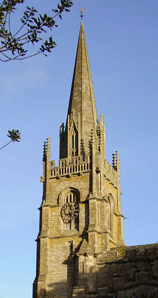
There has been Christian worship on the site of All Saints’ church for over one thousand years and this page aims to give you a brief overview of what is know of the church’s history.
Saxon History
The present church dates from the 15th century but most experts agree that a church stood on this site in Saxon times. The raised site suggest Saxon foundations as churches were build as much for defence as worship during this period.
The Saxon church would’ve been of wood construction and probably succeeded by a stone Norman church of which there is also no trace.
Norman Church
After the Norman conquest however it is known that the Lordship of Cary was given to the Flemish mercenary Walter of Douai who has fought alongside William the Conqueror at the Battle of Hastings. Walter was responsible for building the first part of the castle at Cary from which the town takes its name. After Walter of Douai’s death in 1090 the living of Cary passed to the Priory of Bath and remained in their possession until the Reformation. Records of the incumbents at All Saints’ begin in 1269 when Henry de Risendon was installed.
Little is know about the history of the church in medieval times unfortunately as the earliest surviving parochial records are from 1564, during the reign of Elizabeth I. The antiquarian John Leland did travel through Castle Cary however on his travels throughout England between 1540 and 1546 for Henry VIII and detailed his visit.
Present Building
Most accounts date the present building to the “period of Henry VI” (1422 – 1471) and this is consistent with the style of the church. Like most churches of the period All Saints’ is an example of the late gothic perpendicular style with its soaring heights and broad windows.
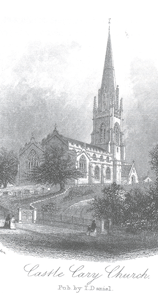
It is uncertain why the church was built at this time but a likely explanation is that despite the destruction of the castle in the 12th century, Cary was growing as a market town and a centre for cloth production.
Civil War
All Saints’ suffered during the Civil War when Cromwell’s troops desecrated it and destroyed the organ. The puritans were suspicious of “wanton and lewde trifling, with piping of organs” and Parliament ordered in 1644 that all church organs be demolished.
It seems that the church fell into some neglect at this time as by the 18th century the vicars did not even bother living in the parish. The period also saw feelings for the Anglican church running high however, possibly for political as well as spiritual reasons; new galleries were built, a new organ was installed and there was an active choir. When a Methodist preacher came to Cary in 1748 he was thrown in the duck pond!
Cary also had one of the first Sunday schools in the country and in 1785 a resolution was passed that all children over seven who did not attend were to be locked up in the round house prison on Bailey Hill.
Parson Woodforde
A rich glimpse of life at All Saints’ and St Andrew’s is available from this period thanks to the diaries of Parson James Woodforde (1740 – 1803) who gives a vivid account of the life of a rural vicar at the end of the 18th century. Woodforde’s father was vicar at Ansford and he became curate himself in 1765 and remained until 1775 when he took up a living in Norfolk at All Saints’ Weston Longville.
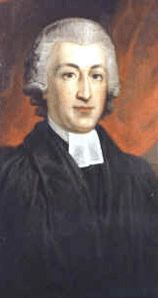
Woodford was typical of the worldly clerics of the time; a man who enjoyed good living and wine but who was also possessed of good sense and a practical manner.
Woodford’s diaries supply many amusing anecdotes of parish politics in Cary and Ansford. In 1768 the Justice summoned the churchwardens of Cary to court for not taking action against a man “making riot in the gallery at Cary Church a few Sundays back”. The parishioners’ response was to burn an effigy of the Justice in front of his house in protest.
A year later in 1769 Woodforde fell out with the singers because they “had the impudence to sing the response” after he had sent a parish clerk to tell them not to do so. As a result they stayed away from church for several weeks before calm was restored on Christmas Eve when they came to sing carols at the Parsonage.
The image of Parson Woodforde displayed here is used by permission of the PCC of All Saints’ Weston Longville.
Victorian Modernisation
In 1845 work was carried out to enlarge the church by the Diocesan architect Benjamin Ferrey as there were concerns that there were only 45 ‘free’ seats. According to the custom of the time certain pews were reserved for influential local families. By the time Ferrey had completed his work the church could accommodate 730 people with 363 ‘free’ seats.

To achieve the extra seating Ferrey lengthened the nave, increasing it by one bay and redesigned the chancel. He also rebuilt the tower to extend the height from 86 to 139 feet. Given the already raised location All Saints’ steeple is a local landmark clearly visible across the Somerset levels.
Recent History
Little has changed since Ferrey’s time; new windows and a new organ were installed in the 19th century and in the 1950s the galleries were removed so that the original shape and function of the building can now be better appreciated.
History of St Andrew’s
The church, which is dedicated, like Wells Cathedral, to Saint Andrew, certainly existed in the early 14th century. Of the mediaeval structure only the tower and some pieces of carved stone, incorporated in the walls of the new chancel and nave, remain.

Inside, can be seen the font, the oldest artifact in the church, dating back to the 12th century. The pulpit is Jacobean and would have been used by the diarist Parson Woodforde during his time at Ansford. The arch leading from the nave to within the tower is particularly graceful and is almost certainly part of the original building.
On the west wall is a list of the parish priests of Ansford dating from 1328. Against the north wall of the chancel stands a carved muniment chest, probably of the early 16th century.
The ancient bell frame was designed to house three bells, the usual arrangement in village churches in pre-reformation times. Soon after the reformation the bell frame was extended to house a fourth bell – this would have been the arrangement in about 1620. The bells were probably re hung in the early 19th century.
The present restoration has allowed for augmentation to a peal of six, the bells being hung in a new steel frame. The original wooden frame has been preserved and retained in the tower.
Catholic History
There was a time when Catholics in Castle Cary & Ansford had never had it so good. Not only was there a priory in Castle Cary, but the nearby mother church in Wincanton was administered by the Carmelite Order, and always fielded at least six priests.
Wincanton at that time also covered Mere, Bruton and Milborne Port as well as Cary . The nuns at St John’s Priory were of the semi-contemplative Benedictine inspired order, The Sisters of Christ Crucified.
The order was unique in that it was the only religious order catering specifically, though not exclusively, for physically handicapped women. Being semi-contemplative the sisters were happy to open their chapel to local Catholics and, indeed, to the whole town on high days and holidays.
Came the time, in 1989, when lack of new vocations, together with the sisters’ increasing age and dependence on each other, meant the dissolution of the priory and dispersal of the sisters to convents in France and the USA. They are still sorely missed by all in Cary & Ansford.
At about the same time the Carmelites moved from Wincanton and it was handed over the the Diocese of Clifton.
Left without a church the Catholics of the area were destitute; their halcyon days were over. But the Church of England vicar at the time, the Rev Patrick Revell, assured them that the Catholics of Castle Cary and Ansford would not be without a church. He, and his successors, together with the parishioners, have made them feel completely at home in St Andrew’s Church, Ansford.
The Methodist minister also expressed the same truly ecumenical promise. Churches Together is alive and well and thriving in Castle Cary!
This arrangement came to a conclusion at the end of 2014 when, due to dwindling numbers, they decided to join their fellows who worship in Wincanton.
The Parish
The towns of Castle Cary and Ansford with a population of 2,750 are situated in South Somerset with views of the Mendip Hills and Glastonbury Tor.
Cary was traditionally a centre of textile production and the town is still home to a horsehair weaving factory – John Boyd Textiles Ltd, established in 1837.
The area is well served for local transport, Castle Cary station is on the main line from London Paddington to Exeter St David’s and is served by an InterCity as well as local services. We are also the nearest station for the Glastonbury Festival. Link for rail information – live train departures from Castle Cary.
On June 19th 2004, Castle Cary was granted Fairtrade Village status
Ansford is recorded in the Doomsday book; it’s name, known then as Almundsford, deriving from the ford over the river Brue, near the home of the Saxon Almund.
After the Norman Conquest the lands passed to Robert Breharvel, whose descendants built the castle of Cary.
In Regency times the road through the village was described as ‘a considerable thoroughfare’ linking Bath and Bristol with the resorts of Weymouth and Sidmouth. At this time there were no less than five coaching inns on Ansford Hill.
The Woodforde family acquired land early in the 18th century and later.
The Ecclesiastical parishes of Castle Cary and Ansford were united to become a single parish benefice in January 2017. The civic business is still carried out by Castle Cary Town Council and Ansford Parish Council, working in co-operation.